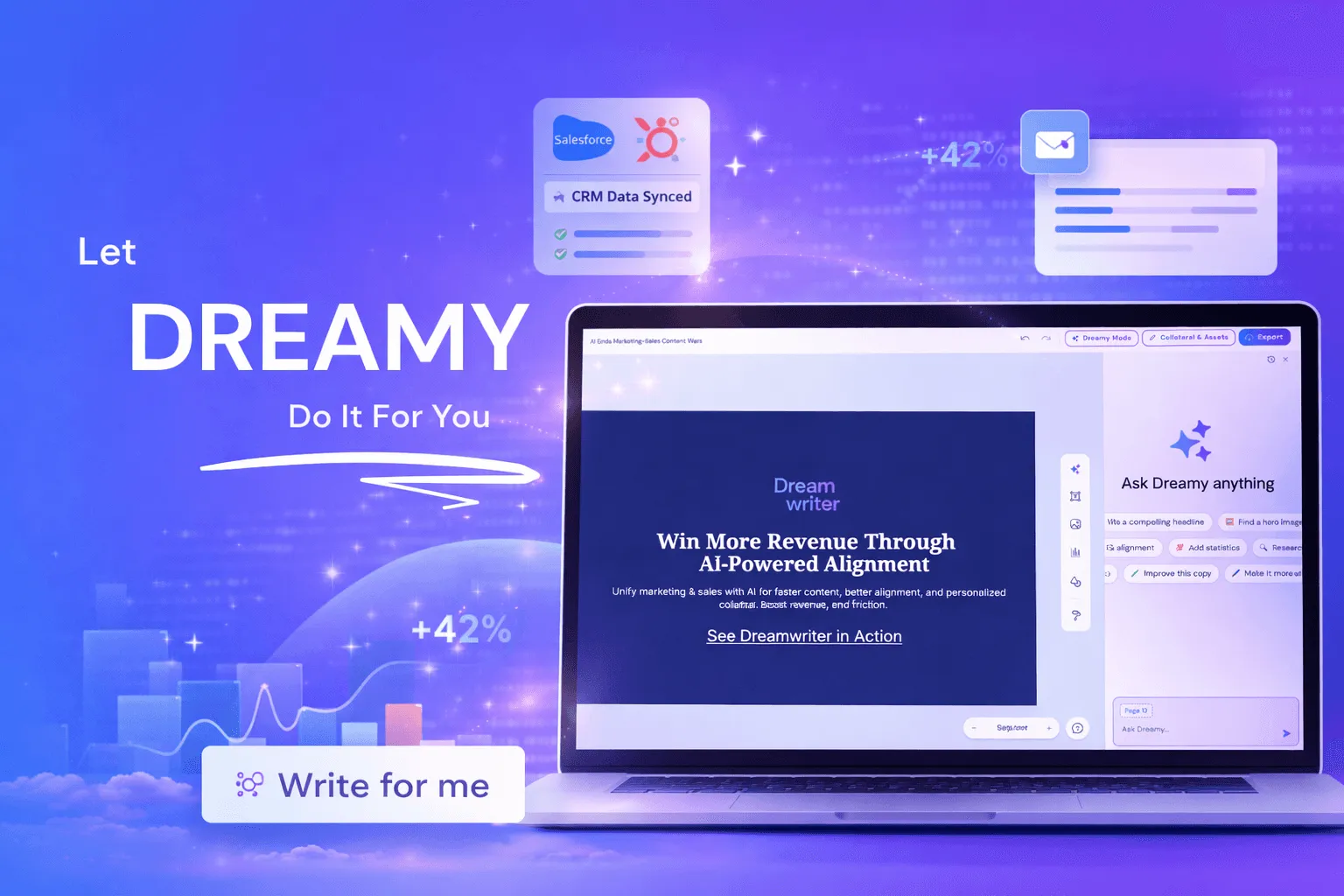
Let Dreamy Write GTM Assets for You
Introduction
Let Dreamy write GTM assets for you is quickly becoming a necessity, not a nice-to-have, for modern revenue teams.
VPs of Sales and Marketing are under more pressure than ever to move faster, personalize deeper, and prove revenue impact. At the same time, content production is becoming a bottleneck. Decks stall in review. One-pagers pile up in version control. Reps wait days for follow-up collateral while deals cool off.
The problem is not a lack of effort or ideas. It is that manual content creation cannot keep up with the pace buyers now expect.
This blog explains what it really means to let Dreamy write GTM assets for you, why it matters heading into 2026, and the practical strategies GTM leaders are using to turn content into a revenue engine instead of a drag on pipeline.
What Does It Mean to Let Dreamy Write GTM Assets for You?
At its core, letting Dreamy write GTM assets for you means shifting content creation from a manual, fragmented process to an automated, performance-driven workflow.
Traditionally, GTM content follows a familiar pattern. Marketing creates core messaging. Sales requests custom versions. Design gets involved. Edits stack up. By the time the asset is ready, the buying moment has often passed.
Letting Dreamy write GTM assets for you changes that flow entirely.
Instead of starting from scratch, Dreamy uses your existing brand messaging, sales collateral, and CRM data to generate assets instantly. These assets are not generic drafts. They are personalized by role, industry, use case, and deal context.
In the old model, personalization was limited by time and headcount. In the new model, personalization becomes the default because it is automated, scalable, and measurable.
Why Letting Dreamy Write GTM Assets for You Matters in 2026
Buyer behavior has changed permanently. Executives expect relevance immediately. Generic follow-ups are ignored, even when they look polished.
At the same time, AI-driven search and answer engines are reshaping how buyers discover, evaluate, and validate vendors. Content now needs to be precise, contextual, and consistent across channels.
According to Gartner, by 2026, 80 percent of B2B sales interactions between suppliers and buyers will occur in digital channels. This means most buyer impressions happen through content, not conversations.
McKinsey also reports that B2B companies using advanced personalization generate up to 40 percent more revenue from those activities than average performers.
The implication is clear. Speed and relevance are no longer competing priorities. They must exist together.
Letting Dreamy write GTM assets for you enables that balance. It allows teams to respond faster without sacrificing message quality or brand control, which is critical as AI-driven buying journeys become the norm.
Best Practices for Letting Dreamy Write GTM Assets for You
Start with real GTM inputs, not blank prompts
High-performing teams feed Dreamy their actual sales decks, positioning docs, and CRM notes. This ensures outputs reflect how deals are really sold, not how they are described in theory.
Anchor personalization to buyer roles and pains
Instead of one-size-fits-all messaging, Dreamy adapts content to the specific concerns of CROs, VPs, and operators. This makes relevance obvious within seconds.
Use Dreamy for follow-ups, not just first-touch content
Follow-up moments are where deals are won or lost. Generating recap decks, one-pagers, and tailored emails immediately after meetings keeps momentum high.
Standardize guardrails, not outputs
The best teams define brand voice, messaging pillars, and design rules once. Dreamy enforces them automatically so sales can move fast without going off-brand.
Treat content as a performance asset
Every asset generated by Dreamy is an opportunity to learn. Track what gets replies, meetings, and progression, then feed that insight back into future campaigns.
Replace manual revision cycles with real-time iteration
Instead of waiting days for edits, teams use Dreamy to refine messaging in minutes based on buyer feedback and deal stage.
How VPs of Sales and Marketing Apply This in Practice
For Sales leaders, letting Dreamy write GTM assets for you means reps no longer wait on marketing to personalize collateral. They walk into meetings with relevant materials and leave meetings with follow-ups that feel bespoke.
For Marketing leaders, it means fewer bottlenecks and higher leverage. Core messaging is created once, then activated across dozens or hundreds of personalized variations without additional effort.
In practice, this often results in shorter sales cycles, higher reply rates, and fewer stalled deals. Teams spend less time formatting and more time selling.
The biggest shift is cultural. Content stops being something teams argue over and starts becoming something that drives alignment and revenue.
Monitoring and Improving Results Over Time
To maximize impact, GTM leaders should track metrics tied directly to revenue outcomes.
Key indicators include response rates on personalized follow-ups, time-to-send post-meeting collateral, conversion rates between deal stages, and overall sales velocity.
Dreamy supports this by closing the loop between content creation and performance. Assets are not just generated, they are evaluated. What works informs what comes next.
Over time, this creates a compounding advantage. The more Dreamy is used, the more precise, on-brand, and effective its outputs become.
The Future of Letting Dreamy Write GTM Assets for You
As we move deeper into 2026, GTM teams that rely on manual content workflows will struggle to keep up. Buyers will not slow down. Expectations for relevance will continue to rise.
Letting Dreamy write GTM assets for you is not about replacing humans. It is about removing friction so humans can focus on strategy, relationships, and outcomes.
This is where Dreamwriter enters the picture.
Dreamwriter is built specifically for bottom-of-funnel performance. It combines your brand voice, sales messaging, and CRM data to generate hyper-personalized GTM assets at scale. More importantly, it learns from real-world results so content improves over time.
Frequently Asked Questions
What does it mean to let Dreamy write GTM assets for you?
It means using AI trained on your brand and CRM data to generate personalized sales and marketing assets automatically.
Why is letting Dreamy write GTM assets for you important in 2026?
Because buyers expect instant relevance and AI-driven channels demand faster, more precise content delivery.
How can VPs of Sales apply this approach?
By using Dreamy to generate role-specific decks, follow-ups, and one-pagers immediately after buyer interactions.
How does Dreamwriter support this strategy?
Dreamwriter connects content creation, CRM data, and performance feedback into a closed loop that improves results over time.
Footnotes
- Gartner. Future of Sales: Digital-First Buying Journeys. 2025.
- McKinsey & Company. The Value of Personalization in B2B Growth. 2025.