Your Donors Gave to Help You Achieve Your Mission. Give Them Something Personal Back.
Your donors gave so you could do the work. Before GivingTuesday, here is how to give them something personal back, in a way that fits the hours your team actually has.
Dreamwriter
3 min read
In this article· 6
Your donors gave so you could do the work. The least you can give back is something that shows you noticed.
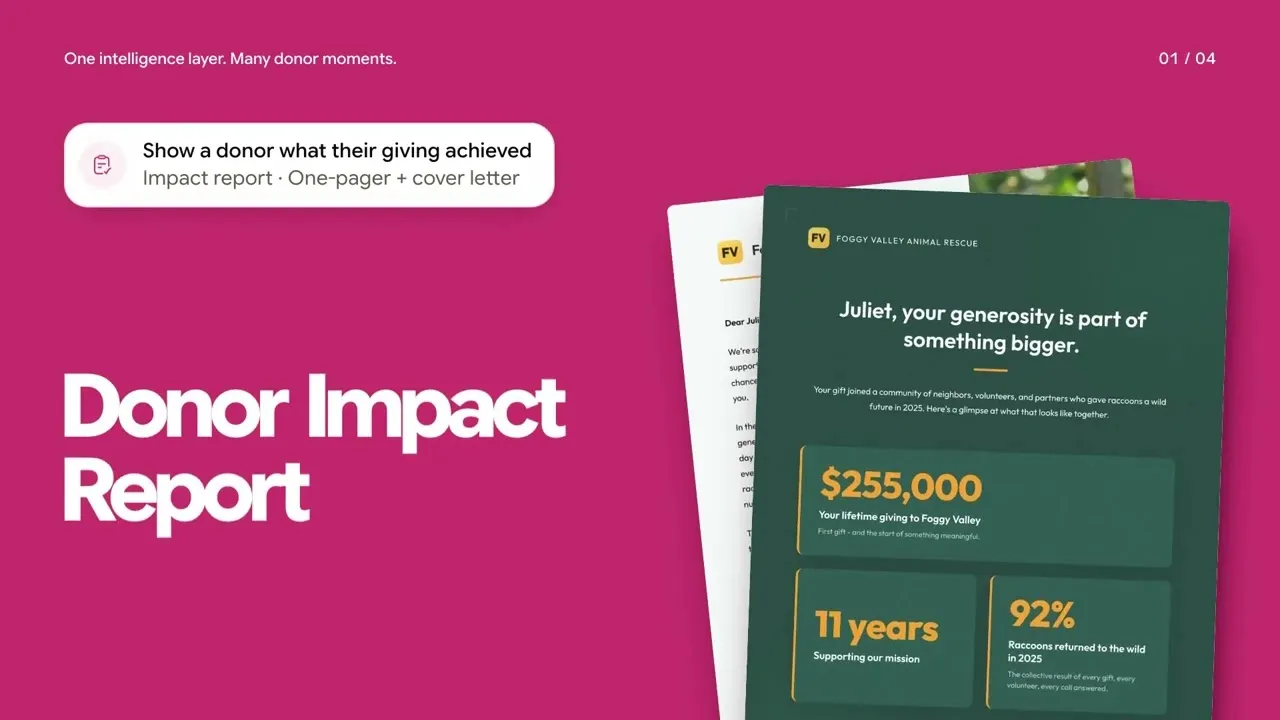
Meet Juliet. The thank-you below is what it looks like when it is written for her instead of for everyone.
The letter that starts “Dear Friend”
Most donors never get what Juliet gets. They get a receipt, then a newsletter, then a letter that begins “Dear Friend,” because there is no name in the file that anyone has the hours to write to.
That is not a failure of caring. Development teams are small, GivingTuesday is a few weeks out, and the donors at the top of the file already take every spare hour. The top tier gets a call, a note, a name. Everyone else gets the template.
It is worth saying plainly what that costs. A donor who gave and heard nothing specific back has learned that the gift disappeared into a general fund. The next ask lands on a person who was never shown what the last one did.
What something personal actually means
A personal thank-you is not a first name in the greeting. It passes three tests.
It names what the gift did. Not what the organization did last year, but the program, the fund, or the outcome that donor’s money touched.
It sounds like a person on your team. Your voice, your way of describing the work, not a template with the blanks filled in.
It arrives while the gift still feels fresh. A specific thank-you inside 48 hours reads as gratitude. The same words three weeks later read as administration.
Why this is hard, and where the hours go
If writing one good letter were the whole problem, every team would write them. The real work is assembling the context behind the letter: the giving history in the CRM, the outcome in a program report, the story someone approved last spring, the way your organization talks about itself. We wrote about this tradeoff in The False Choice in Donor Stewardship. The bottleneck was never the sentence. It was gathering everything the sentence depends on.
What Dreamimpact does
Dreamimpact™ takes that assembly off your team. It reads a donor’s history with you, the outcomes of the programs they funded, the stories you have already approved, and your organization’s voice and guardrails, then drafts the letter a person would have written if they had the hours. Impact reports, donor updates, acknowledgments, and meeting briefs all come from the same source material you already own.
Nothing sends itself. Your team reviews each piece before it reaches a donor, so the judgment stays with the people who know them.
The result is the thing in the video: a thank-you that reads like someone who knew Juliet wrote it, available for the donor who gave $250 as well as the one who gave $25,000.
Before December 1
GivingTuesday is Tuesday, December 1. You do not need to transform your whole program in the next few weeks. Three moves are enough.
Pick one group of donors who usually get the generic version. First-time donors and mid-level donors are a good place to start, because they are the ones most likely to drift without a reason to stay.
Gather one outcome and one approved story for each program they funded. You likely already have both.
Commit to the 48-hour window. Decide now who sends the thank-yous on December 2, and what they will say.
See it with one of your own donors
Would it be a bad idea to see what Juliet’s thank-you would look like for one of your own donors? Book a short walkthrough with Ricky and bring one donor along.
https://dreamwriter.ai/dreamimpact/demo/
And if this is not for you, it may be for someone you know: a board you sit on, a school, a foundation, anyone who has to thank donors properly and never has the time.
- Nonprofit
- Donor Stewardship
- GivingTuesday
- Hyperpersonalization
- Dreamimpact