One Brand, Forty Voices: How Universities Escape the Marcomm Bottleneck
Every school on campus has stories worth telling and a queue standing between those stories and the people who want to hear them. The fix is not more gatekeeping or less. It is a federated model, made workable by hyperpersonalization.
Dreamimpact by Dreamwriter | University series, week 1 | Companion to the Aug 26 LinkedIn post
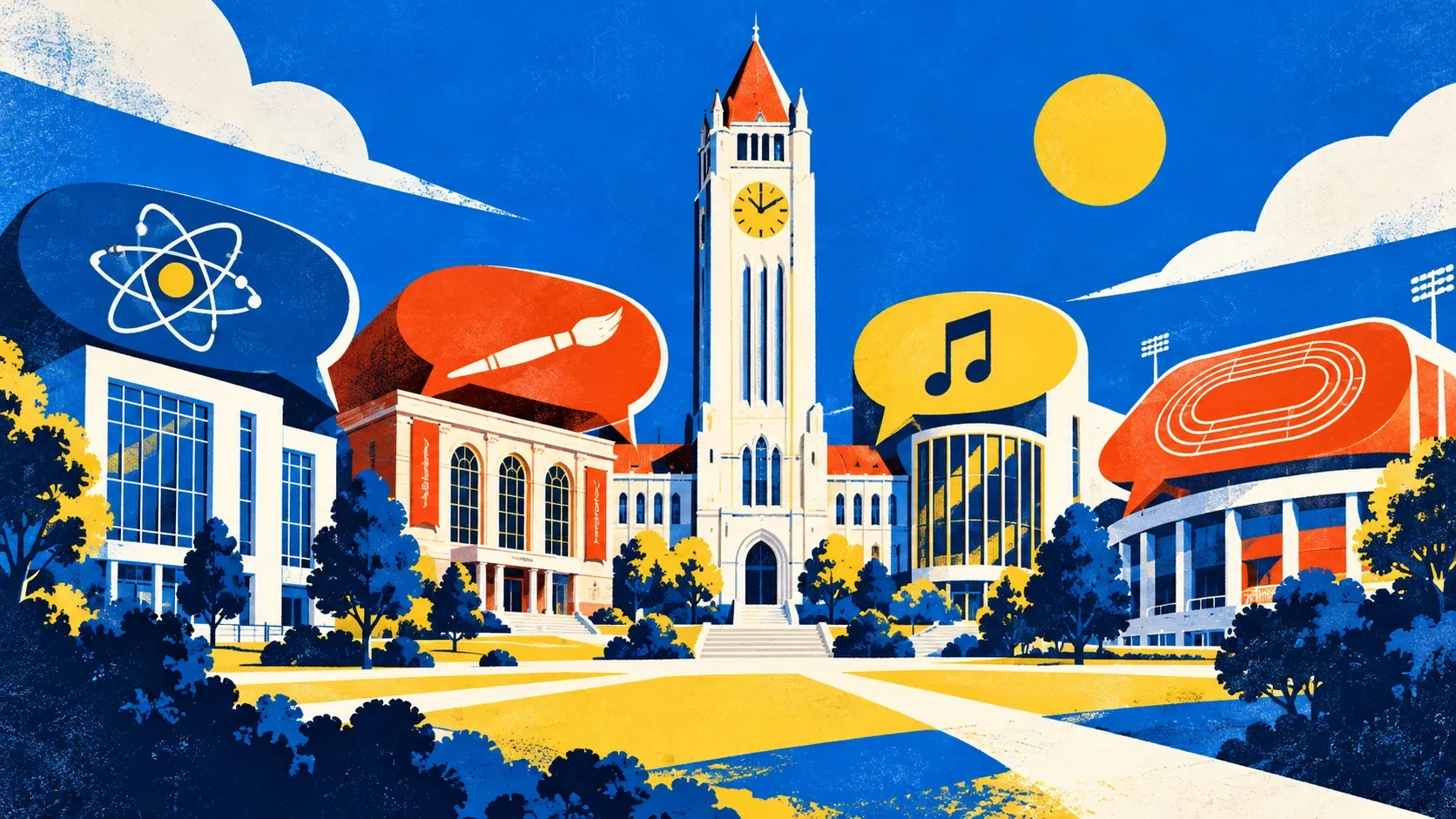
Six schools. Forty departments. Hundreds of faculty, teams, labs, and student organizations, each generating the kind of stories that make alumni proud and donors generous. And, at the center of it all, one central marketing and communications office through which most of those stories must pass. Every university communicator knows what happens next. The stories queue. The queue grows. The engineering school’s research breakthrough waits behind the capital campaign update, which waits behind commencement, and by the time the queue clears, the moment has passed.
The bottleneck is nobody’s fault. Central marcomm exists for good reasons: the university’s brand is a real asset, tone and standards matter, and a decade of decentralized chaos taught most institutions why guardrails exist. But the cost of the queue is real too, and it is paid in stories that ship late or never ship at all.
The false choice every campus faces
Most universities believe they are choosing between two bad options. Centralize everything, and quality stays high while volume collapses and every school resents the wait. Decentralize everything, and volume returns while the brand fragments into forty inconsistent voices, off-template decks, and the occasional reputational fire. Institutions oscillate between these poles for years, tightening after an embarrassment, loosening after a backlog.
The way out is a federated model: schools and units produce their own content, in their own voice, inside guardrails that central sets and maintains. Editorial standards, brand language, messaging priorities, and approval rules live at the center. Production lives at the edges, close to the stories. Central marcomm stops being a chokepoint and becomes what it always wanted to be, a standards body and a strategic partner.
Federation fails, historically, for one reason: it has been operationally impossible. A style guide PDF cannot enforce itself, and forty communicators of varying skill cannot all internalize the brand voice. Which is exactly the problem hyperpersonalization solves.
How Dreamwriter makes federation actually work
Dreamwriter does what it does so effectively because it builds a deep, layered context model of the institution before it generates a word. At the top layer sits the university’s brand: voice, values, editorial standards, the phrases it uses and the ones it never uses. Beneath that, each school and unit gets its own layer: the engineering school’s technical register, the arts school’s warmth, athletics’ energy, each learned from that unit’s own best material. When someone in the business school drafts a story, the platform writes inside both layers at once, unmistakably the university, unmistakably that school.
That is the production half. The distribution half is where hyperpersonalization changes what a university can do at all. Alumni do not have a relationship with the university in the abstract. They have a relationship with a school, an era, a team, a professor, a residence hall. Mass communication flattens all of that into one homogenized newsletter, which is why so much of it goes unread. Hyperpersonalization keeps the specificity: the 2009 mechanical engineering graduate reads about the robotics lab she remembers, framed by the professor she took senior design with, while the 1988 theater alum reads about the stage he performed on. Same institution, same week, personally relevant to each of them.
For advancement teams, this is the difference between broadcasting and cultivating. Giving-day appeals grounded in the donor’s own school and class year consistently outperform generic institutional asks, and stewardship reports that name the specific lab, scholarship, or program a gift touched are the ones that get replies. Producing that specificity by hand for fifty thousand alumni was never possible. Producing it from a shared context engine is Tuesday.
What the guardrails actually contain
Federation lives or dies on the quality of its guardrails, so it is worth being concrete about what central actually defines. The first layer is voice and language: the institutional register, the approved names for schools, programs, and campaigns, the claims that require attribution, and the phrases the general counsel never wants to see again. The second is editorial standards: sourcing expectations, photo and accessibility requirements, how student and patient privacy is handled in stories. The third is routing: which content types publish freely, which need a unit communicator’s sign-off, and which small set, crisis communication, rankings claims, anything touching litigation, still escalates to central every time.
In the old model those rules lived in a PDF that nobody opened after orientation. In Dreamwriter they live in the system that produces the content, which changes their character entirely. A guardrail that enforces itself does not need a gatekeeper, and drift, the slow divergence of forty units from the brand, stops being something central discovers in an audit and becomes something the platform quietly prevents on every draft. Central marcomm’s job shifts from inspecting outputs to tuning the rules, which is both a smaller job and a more strategic one.
The same layering answers the fear every provost raises: what happens when the platform is wrong? The answer is that nothing publishes itself. Federation moves drafting to the edges, not judgment. The unit communicator who knows the lab, the coach, or the donor still reads every word, and the review that once took three weeks in a queue takes minutes at a desk, because the draft arrived already inside the lines.
Built for how campuses actually buy
Universities are not one buyer but two. On some campuses, content infrastructure is a central IT decision, evaluated for security posture, integration, and governance. On others, the advancement foundation, often a separate 501c3 with its own budget and board, moves first and proves the model. Dreamimpact is deployed both ways: as an institution-wide platform under central governance, or as a foundation-led rollout that starts with advancement and expands school by school. Federation is not just the content model. It is the adoption model, which means a single school or the foundation can pilot without waiting for a campus-wide decision.
What a federated semester looks like
Picture homecoming through this lens. The athletics department drafts its recap in its own voice the same afternoon. The alumni association turns the weekend into class-year-specific follow-ups: photos and stories weighted toward each recipient’s era. Advancement sends major donors a stewardship note connecting the new scholarship cohort they funded to the students who walked at halftime. The engineering school, whose reunion tent hosted three hundred graduates, follows up with a lab-tour invitation personalized by degree program. Central marcomm reviewed none of it line by line and approved all of it, because the guardrails were in the system before anyone typed a word.
One weekend became a quarter of touchpoints, and every touchpoint was specific to the person receiving it. That is the federated campus: brand-whole at the center, personally relevant at every edge.
The measurement follows the same shape. Institutions running federated models watch time-to-publish collapse first: stories that took three weeks to clear a queue ship in days. Then the mix shifts, with a growing share of published content originating in schools and units rather than the center. The numbers advancement cares about move last but matter most: open and response rates on era-specific and school-specific alumni communication against the old all-institution newsletter, and giving-day conversion where the ask named the donor’s own school. Each is a proxy for the same underlying change: the institution stopped speaking at fifty thousand people and started speaking to them.
The academic calendar is a content engine
One more advantage universities hold over every other institution: the calendar does the editorial planning for you. Move-in, convocation, homecoming, giving day, championship season, admitted-students weekend, commencement. Each is a predictable spike of stories, emotion, and attention, and each lands differently for different audiences: an admitted student’s family, a senior’s, a 1995 graduate’s. An institution with a federated production model and a hyperpersonalization layer can plan a full year of communication around moments it already knows are coming, then let each moment reach every audience in the form that audience actually wants.
Most campuses currently experience the same calendar as a series of fire drills, with central marcomm sprinting to cover each moment generically because covering it specifically was never operationally possible. The infrastructure is the difference between the two experiences. The moments were always there. The capacity to honor them, school by school and reader by reader, is what changes.
If your stories are stuck in a queue, the queue is the problem, not your people. Dreamimpact pairs Dreamwriter’s context engine with onboarding built for federated institutions, so central sets the guardrails once and schools start producing in their first week. If you would like to see your own school’s voice inside your university’s brand, we would be glad to show you with your material. And if you serve on an alumni board or a foundation committee, forward this to the communicator who will know exactly which queue we mean.